Gandhian Management by Ram Pratap
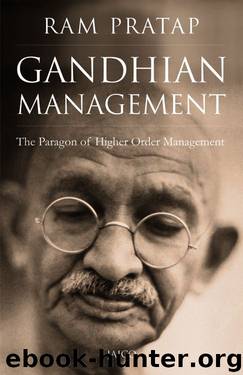
Author:Ram Pratap [Pratap, Ram]
Language: eng
Format: epub
Tags: Mobilism
Publisher: Jaico Books
Published: 2013-02-04T00:00:00+00:00
MANAGEMENT BY EFFECTIVE
COMMUNICATION AND
INFORMATION FLOW
* * *
6
O
ne most intriguing lesson to learn from the history of Gandhi's life is how he established a strong link with people of all rungs and strata, particularly the masses spread across the country including far-flung rural, hardly reachable, and inhospitable areas, and how he managed to unite and mobilise them timely to follow his instructions and directions voluntarily. Regardless of the place from where he activated his programmes or launched his movements in the form of civil disobedience (satyagrah) and strike (hartal), his words moved people of all backgrounds.
Effective communication, which means a package of information, designed and delivered with proper content, method and channel, is vital to bringing about a directed change in the perception of the target group. Since information and perception are mutually interactive and interdependent, the alloyed information can distort the perception, while the distorted perception can alloy the information. The communication should, therefore, be made with caution and candour in order to impress a positive effect on the listener. Correspondingly, people contributing to the process of information flow, are required to have special traits, i.e. intellectual soundness, emotional maturity, unwavering tolerance and objective orientation. Otherwise, the information would lose its conformity with reality, and communication would deviate from its purpose.
Gandhi evoked people's right to freedom of communication with each other as a doctrine of natural justice, which is clear from his following statement1: "If the luxury of wires be denied to us, we must manage with the post. If the postal communication be also stopped, we must use messengers. Friends travelling to and from will oblige us. When the use of railways is denied, we must use other methods of conveyance. No amount of slowness imposed can checkmate us, if we are sure within." Any restriction imposed on the right to communicate freely, and right to access information would be tantamount to curtailing many other freedoms, including economic freedom which is contingent upon communication and access to relevant information.
George A. Akerlof, A. Michael Spence and Joseph E. Stiglitz, worked on the formulation of models2 to explain how imbalances in information possession impact economic conditions, and they won the Nobel Prize in Economics for the year 2001. They proposed a common explanation in their analysis, with the realistic assumption of asymmetric and askew information to answer many familiar but probing questions: Why are interest rates often excessively high on local lending markets in third world countries? Why do people who want to buy a good used car turn to a dealer rather than a private seller? Why does a firm pay dividends, even if they are taxed more heavily than capital gains? Why do rich land owners not bear the entire harvest risk in contracts with poor tenants?
Gandhi empowered common men by providing necessary inputs through oral communication and printed information dissemination, so as to enhance their awareness, augment their knowledge and raise their cognition level, all prerequisites to acquiring the ability to differentiate between right and wrong, identify threats and opportunities and recognise one's rights and responsibilities.
Download
This site does not store any files on its server. We only index and link to content provided by other sites. Please contact the content providers to delete copyright contents if any and email us, we'll remove relevant links or contents immediately.
Hit Refresh by Satya Nadella(9122)
The Compound Effect by Darren Hardy(8941)
Change Your Questions, Change Your Life by Marilee Adams(7754)
Nudge - Improving Decisions about Health, Wealth, and Happiness by Thaler Sunstein(7689)
The Black Swan by Nassim Nicholas Taleb(7104)
Deep Work by Cal Newport(7059)
Rich Dad Poor Dad by Robert T. Kiyosaki(6602)
Daring Greatly by Brene Brown(6501)
Principles: Life and Work by Ray Dalio(6413)
Playing to Win_ How Strategy Really Works by A.G. Lafley & Roger L. Martin(6219)
Man-made Catastrophes and Risk Information Concealment by Dmitry Chernov & Didier Sornette(6001)
Big Magic: Creative Living Beyond Fear by Elizabeth Gilbert(5753)
Digital Minimalism by Cal Newport;(5747)
The Myth of the Strong Leader by Archie Brown(5495)
The Slight Edge by Jeff Olson(5409)
Discipline Equals Freedom by Jocko Willink(5377)
The Motivation Myth by Jeff Haden(5202)
The Laws of Human Nature by Robert Greene(5170)
Stone's Rules by Roger Stone(5080)
